The January POV
Why the women who seem okay are often the ones who need help most.
01 — The Silence
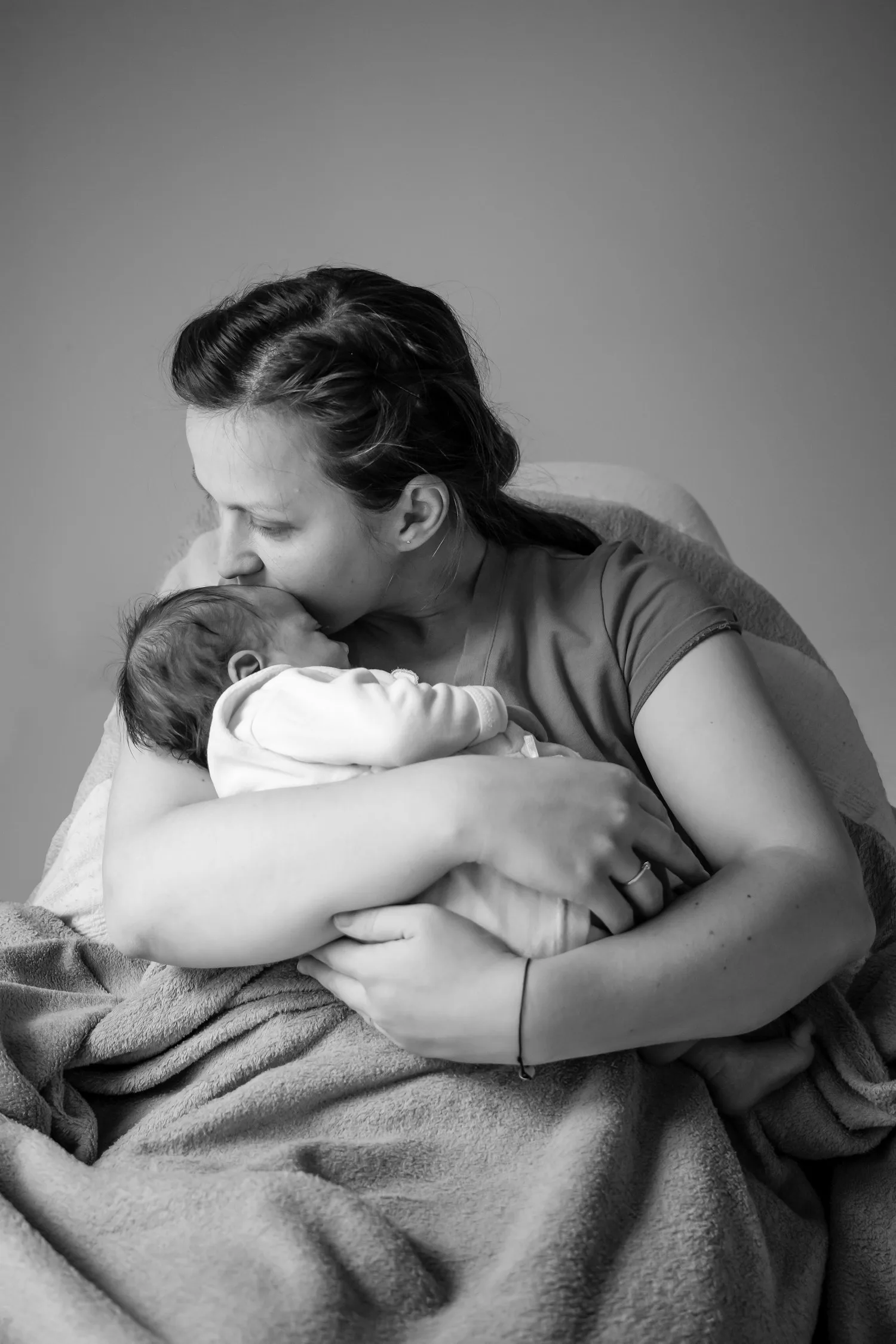
You thought you'd feel settled by now. The visitors have gone home. Your partner is back at work. The last OB appointment is behind you — you were cleared. On paper, everything is fine.
What arrives instead is a strange kind of silence. And in that silence, a lot of questions you don't know how to ask, or who to ask them to. The newborn chaos was exhausting, but at least it was loud. This quiet is different. It's deafening.
If you've been through it, you recognize this moment. If you're heading toward it, this is what nobody tells you to prepare for. The women who seem most okay in postpartum are frequently the ones who need the most support — and the least likely to ask for it.
02 — The Biggest Lie
Dr. Hila Sachs, a clinical psychologist at Bloom Parenthood, describes the six-week clearance this way: "The clinical scaffolding is completely taken down before the psychological foundation is even dry yet."
The OB checks that your body has healed. What doesn't get checked is everything that happens next — the identity shift, the grief for who you used to be, the longing to be taken care of while you're busy taking care of a newborn.
The biggest lie we're led to believe is that once the newborn phase is over, we'll be back to our normal selves.Dr. Hila Sachs · Clinical Psychologist, Bloom Parenthood
And here's what makes it harder to see: the women who are struggling most are often the ones who look fine from the outside.
High-achieving women — those who have succeeded professionally, academically, personally — are disproportionately likely to mask what they're experiencing. The cultural conditioning is deep: needing help signals weakness. Not being back on your feet signals failure. And so women maintain a version of themselves for friends, for family, for colleagues — appearing to have moved on long before they actually have.
Dr. Sachs has seen this play out in a striking way. The Edinburgh Postnatal Depression Scale (EPDS), one of the most widely used postpartum screening tools, is easy to misrepresent: "You end up going to the doctor's office wanting to appear like everything is good and just lying. It's so easy to just be like, I'm okay, I'm okay, I'm okay."
For high-achieving women already conditioned to push through, a ten-minute appointment offers little resistance. This isn't a character flaw. It's a pattern — and it has consequences.
A Gap No One Is Filling
1 in 5
pregnant or postpartum women will experience a perinatal mood or anxiety disorder. Most will never be diagnosed.
63%
of U.S. maternal deaths occur in the first year after birth — not during delivery.
#1
Mental health is the leading cause of maternal mortality — nearly 1 in 4 pregnancy-related deaths.
Sources: Dennis et al. 2017 · Commonwealth Fund 2025 · CDC Maternal Mortality Review Committees
It's because the system is designed to stop looking. Postpartum depression and anxiety are now understood to peak not in the first weeks, but between four and six months after birth — well after the cultural narrative says the hard part should be over.
The problem is structural, not personal. Asking for help used to be built into how postpartum worked — the village was literal, not metaphorical. Multi-generational households, extended family nearby, neighbors who knew your name. That infrastructure has largely disappeared, replaced by nuclear families, geographic mobility, and dual-income households. The biological need for community hasn't changed. The community has.

What fills the gap instead is often a late-night scroll through other people's curated highlight reels — not because new mothers lack discipline, but because loneliness is looking for a signal and the algorithm is the easiest place to find one. The scroll isn't the problem. It's a symptom.
04 — Getting Help
The barriers to support are real: finding a therapist who takes your insurance, who has availability, who you feel connected with — while simultaneously keeping a newborn alive. Dr. Sachs puts it plainly: "On top of the mental load you're carrying, having to go through all of these systemic hoops to try to find help is going to discourage you."
The answer isn't pushing through it. It's changing the conditions so that asking is possible. Dr. Sachs describes what genuinely effective postpartum support requires:
01
No systemic hoops. Help you can reach the moment you need it — including at 11pm in the nursing chair.
02
Not a single appointment where you start over from scratch. Support that shows up regularly, over months.
03
Care that already knows your story and meets you exactly where you are.
Equally important: planning for this before birth. Setting up a support team during pregnancy — a therapist you've already met, a lactation consultant whose number you already have — means that when the scaffolding comes down and the silence arrives, the door to help is already open.
Real support is not a luxury. It's not an indulgence. It's absolutely not a personal failure. It is a necessity.Dr. Hila Sachs
Asking for help is the most competent, self-aware thing a postpartum woman can do in response to a situation that was genuinely never designed to be navigated alone.
05 — The Village
At January, we believe the village doesn't disappear when the visitors go home. It evolves.
The modern village looks different: a support team that responds when you need it, that already knows your story, that doesn't require you to perform being okay in order to receive care. Virtual, personalized, and built for the reality of how postpartum actually unfolds — not how we wish it did.
That kind of support isn't a luxury. It's what closes the gap the system leaves open. If the silence after the fourth trimester feels louder than the chaos before it, you're not imagining it. And you're not alone in it.
The Modern Village
January is virtual, personalized postpartum support that already knows your story — and shows up well past the six-week mark.
Modern motherhood deserves modern solutions.
The village isn't gone — it's just been reimagined.
← Previous Essay
When your heart tells a story.
Next Essay →
Why personalized postpartum support is essential for professional women.